OPINION
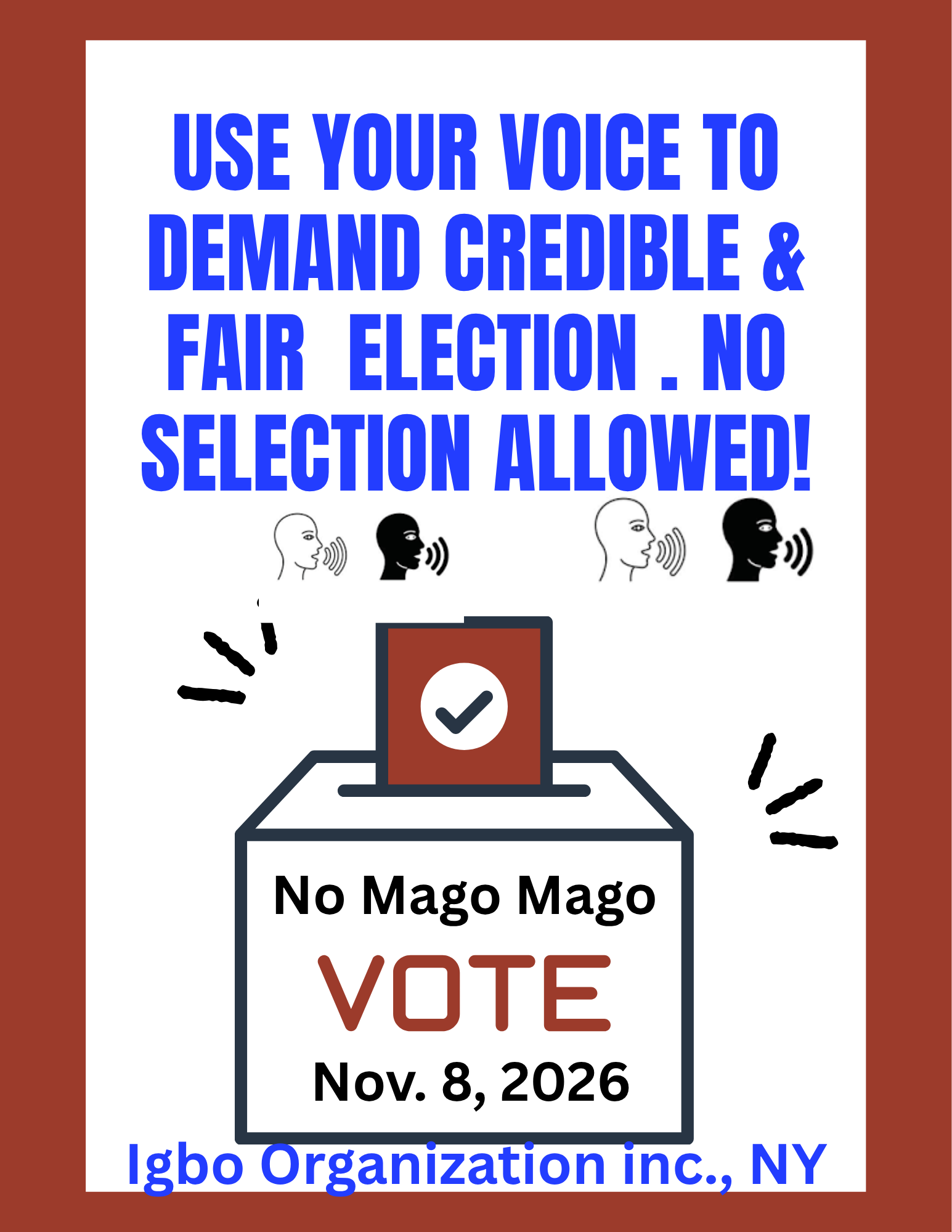
TRUTH BE TOLD! ELECTION MANIPULATION IN IGBO ORGANIZATION INC., NY, DATES BACK TO ITS FIRST ELECTION IN 1991.
Ladies and Gentlemen of Igbo Organization Inc., NY,
The most effective way to solve any serious problem is to make an honest effort to identify and address its root causes. Any solution that merely treats the symptoms without eliminating the underlying problem is nothing more than a temporary patch, destined eventually to fail.
I am deeply disappointed that, to this day, we have yet to demonstrate the collective seriousness required to confront what I consider one of the most pressing problems facing Igbo Organization Inc., NY: election manipulation and rigging.
Whether you agree with me or disagree, whether you like me or dislike me, the historical record deserves an honest examination. In my view, election manipulation in Igbo Organization did not begin with Obed Ariri, Agwu Amah Agwu, or Ifeanyi Ajomiwe-Nwakanma. Rather, the problem dates back to the organization's first official election in 1991.
THE ROOTS OF THE PROBLEM
I contend that the first election in 1991 was marred by serious violations of the organization's Constitution. I identify Ambrose Ezenma and Onyebuchi Ogunka as the principal individuals responsible for what I believe was electoral manipulation. I further contend that certain founding members, motivated by the desire to gain or retain power, supported the process and subsequently ascended to elected positions.
According to my account, the disputed election paved the way for Dr. Uju Nkwocha Afulezi, who joined the organization on election day, to assume a leadership position despite questions at the time concerning whether his membership payment had cleared the bank.
One troubling pattern that I believe has persisted throughout the organization's history is the treatment of perceived opponents. Rather than resolving disagreements through fair procedures, constructive dialogue, and respect for the Constitution, dissenting members have, in my experience, faced harassment, intimidation, special committees, sanctions, and attempts at expulsion.
I count myself, Mazi Ogbonna, among those who have experienced such treatment, along with other members who have challenged the prevailing leadership.
These concerns deserve serious examination, not dismissal or personal attacks. If we genuinely want reform, we must be willing to investigate our history honestly, regardless of whose reputation or interests may be affected.
FROM A CULTURAL ORGANIZATION TO A POLITICAL BATTLEGROUND
The 1991 election marked, in my view, a troubling turning point: the introduction of divisive politics into an organization established primarily to unite Ndigbo around a common cultural purpose.
Igbo Organization Inc., NY, was founded with a noble mission: to promote and preserve Igbo language, culture, heritage, and unity. The vision of acquiring Obi-Igbo was an important part of that mission—a place where our children, future generations, and the wider public could learn about and appreciate the richness of Igbo civilization.
We must therefore ask ourselves a fundamental question: How faithfully have successive administrations pursued the ideals upon which this organization was founded?
Why have the promotion of Igbo language, the preservation of our cultural heritage, and the unification of our people seemingly taken a back seat to leadership disputes, political rivalries, and internal divisions?
These are legitimate questions that deserve clear answers.
An organization cannot fulfill its founding mission when personal ambition consistently takes precedence over collective responsibility. Nor can it build a lasting legacy when leadership becomes an end in itself rather than a means of serving the community.
In my opinion, the persistent pursuit of power, recognition, and personal advantage has become one of the fundamental obstacles to the progress of Igbo Organization Inc., NY.
PERSONAL INTERESTS, FINANCIAL BENEFITS, AND ACCOUNTABILITY
Igbo Organization Inc., NY, cannot reverse its downward trajectory unless religious, sectional, and other divisive loyalties are reduced to a minimum and the interests of the organization are placed above individual or factional interests.
The prevailing attitude of "chop and I chop"—in other words, "Let me benefit today, and I will look the other way until it is my turn"—is a dangerous practice that can undermine any organization, regardless of its cultural mission or legal status.
We must also be willing to examine the financial relationships surrounding Obi-Igbo, including payments to lawyers, DJs, MCs, contractors, vendors, and other service providers.
I have concerns that financial benefits associated with the organization's activities may have influenced the positions taken by some individuals toward successive administrations, including those led by Obed Ariri, Agwu Amah Agwu, and Ifeanyi Ajomiwe-Nwakanma.
I am particularly concerned about whether financial interests and personal relationships have, in some instances, discouraged members from demanding accountability or challenging questionable decisions.
To be clear, the fact that individuals or businesses receive payment from the organization does not, by itself, establish wrongdoing. However, all financial transactions must be transparent, properly documented, and subject to appropriate oversight. No member, officer, professional, or vendor should be above scrutiny.
The expression "stomach infrastructure" aptly describes the danger that arises when personal benefits become more important than principles, accountability, and the common good.
We must stop pretending that these concerns do not exist. The appropriate response is to demand transparency, disclose potential conflicts of interest, and insist on responsible financial management.
THE CHALLENGE BEFORE US
I urge every current member, former member, and newcomer who genuinely desires progress to understand that the problems facing Igbo Organization Inc., NY, cannot be resolved merely by changing presidents or replacing one group of officeholders with another.
My concern is that an entrenched culture of leadership succession, personal alliances, and mutual political accommodation has developed over the years. If this culture remains unchallenged, new administrations may simply reproduce the same practices that have damaged the organization in the past.
We must therefore look beyond personalities and confront the institutional weaknesses that allow manipulation, division, and a lack of accountability to persist.
Igbo Organization Inc., NY, is now an established 501(c)(3) nonprofit organization, a status that brings responsibilities to the public good and to the purposes for which the organization was established.
This raises an essential question: What measurable public good does Igbo Organization Inc., NY, provide if its internal affairs are continually consumed by division, leadership disputes, and the exclusion of members?
A nonprofit organization should not become an instrument for the private advancement of a select group. Its leadership should be accountable to its membership, its Constitution, its stated mission, and its applicable legal obligations.
The organization must demonstrate its commitment to the public good through meaningful cultural education, the preservation of Igbo heritage, the promotion of our language, the development of younger generations, and the creation of an inclusive environment where members can participate without fear of intimidation or retaliation.
THE WAY FORWARD: ADDRESS THE ROOT CAUSES
If we are serious about saving Igbo Organization Inc., NY, I propose that we begin by taking the following steps:
-
Conduct an honest historical review of past elections, beginning with the first official election in 1991, using available records, testimony, and other verifiable evidence.
-
Establish transparent electoral procedures that protect the integrity of membership lists, voting eligibility, ballot counting, and the announcement of results.
-
Enforce the Constitution fairly and consistently, without favoritism, intimidation, or selective punishment.
-
Strengthen financial transparency through proper documentation, independent review where appropriate, and clear disclosure of potential conflicts of interest.
-
End the victimization and exclusion of dissenting members by ensuring that disciplinary procedures are fair, impartial, and consistent with the organization's governing rules.
-
Return to the founding mission by making the promotion of Igbo language, culture, heritage, and unity central to the organization's activities.
-
Demand accountability from every administration, past and present, based on documented actions and measurable results rather than political loyalties or personal relationships.
These measures will not solve every problem overnight. However, they would provide a foundation for rebuilding trust, restoring unity, and returning the organization to its original purpose.
CONCLUSION
My purpose in raising these issues is not to perpetuate personal animosity or condemn individuals without a fair examination of the facts. It is to insist that the truth must be confronted if meaningful reform is ever to become possible.
We cannot continue blaming only the latest president while ignoring the historical practices, institutional weaknesses, and personal interests that may have contributed to our present predicament.
The problem did not begin yesterday, and the solution cannot be limited to changing today's leadership.
If we truly care about Igbo Organization Inc., NY, we must have the courage to examine our past, acknowledge our mistakes, demand accountability, and restore the principles upon which the organization was founded.
Let us stop placing personal ambition above collective progress. Let us stop allowing sectional loyalties and private interests to overshadow our cultural mission. Let us rebuild an organization that our children and future generations can be proud of.
The future of Igbo Organization Inc., NY, depends not on who occupies the president's seat, but on whether we are prepared to restore integrity, transparency, unity, and fidelity to our founding ideals.
APPROACH FOR SUCCESS: RETURN TO OUR ROOTS
1. CONSULT THE FOUNDING MEMBERS
Current and former members should consult the uncompromised founding members of Igbo Organization Inc., NY, to gain a fuller understanding of the organization's history, original vision, and founding principles.
Anyone who deliberately neglects the contributions and historical knowledge of an organization's founders risks becoming part of the problem rather than contributing to its solution.
The founding fathers—yes, the founding fathers, as there were no founding mothers in the original group—had a vision for success. By many measures, that vision achieved remarkable milestones. Why, then, should these visionaries be discarded or ignored because of political expediency, personal rivalries, or the pursuit of recognition and titles?
An organization's history should be a source of knowledge and guidance, not something to be conveniently forgotten when it conflicts with the ambitions of those currently in power.
2. REJECT PERSONALITY POLITICS, SECTIONALISM, AND RELIGIOUS DIVISION
It is both unfortunate and unbecoming of well-meaning Ndigbo to abandon their ROOTS in pursuit of personality hierarchies, titles, political theatrics, or loyalties anchored in religious affiliations and sentiments.
We must ask ourselves why leadership contests and internal disagreements have repeatedly overshadowed the cultural mission of Igbo Organization Inc., NY.
Before jumping to conclusions or taking offense, let us remember a fundamental truth: Igbo Organization is a cultural organization, not a political party, a religious institution, or a platform for professional advancement.
Every member should desist from taking sides merely to favor a brother, sister, friend, or associate from their village, state, or religious affiliation.
No Igbo person is inherently more important or more deserving than another. Our collective strength lies in our shared identity, mutual respect, and willingness to work together.
This was the underlying principle behind the formation of Igbo Organization Inc., NY, when major communities such as Owerri, Mbaise, Umuahia, Okigwe, Asaba, and others had substantial membership representation.
Our differences should enrich our organization, not divide it. Religious beliefs, village affiliations, state origins, and personal relationships must never become instruments for excluding, intimidating, or marginalizing fellow members.
3. LET LIVE, AND LET US LIVE
"Let live, and let us live" must remain our catchphrase.
The expulsion, frustration, intimidation, and victimization of Igbo people within an organization established to promote their common cultural heritage must stop.
No member should be made to feel unwelcome simply because they question a decision, disagree with an officer, challenge an administration, or advocate a different approach.
Healthy organizations welcome constructive criticism. They do not treat disagreement as disloyalty or opposition as an enemy to be eliminated.
For the sake of a better Igbo tomorrow, we must embrace fairness, respect, dialogue, and reconciliation. We cannot preach unity to the wider Igbo community while allowing division and hostility to flourish within our own organization.
4. A PEACEFUL REALIGNMENT IS NECESSARY
All I ask for is a peaceful realignment after the obvious derailments that, in my view, have been encouraged by overzealous personalities seeking attention, recognition, and the opportunity to "shine" at the expense of collective progress.
This is not a call for revenge, hostility, or another round of leadership battles. It is a call for sober reflection, institutional correction, and a renewed commitment to the organization's founding purpose.
We must move away from personality-driven leadership and toward a culture of service, accountability, and collective responsibility.
Let us put the interests of Igbo Organization Inc., NY, above personal ambition. Let us create an environment in which capable members can contribute freely, founding principles are respected, and leadership is measured by service rather than self-promotion.
The time has come for members to put aside their differences, examine the facts, and work together toward a more transparent, inclusive, and culturally focused organization.
5. WE HAVE A RESPONSIBILITY TO OUR CHILDREN
WE HAVE FAILED OUR CHILDREN, AND A RESET IS OVERDUE!
Our children and future generations deserve more than an organization consumed by internal disputes, political rivalries, and struggles for titles and recognition.
They deserve an organization that teaches them the Igbo language, preserves our cultural heritage, celebrates our history, promotes our values, and gives them a reason to be proud of their identity.
They deserve an Obi-Igbo that represents unity, learning, cultural pride, and community development—not a symbol overshadowed by endless leadership disputes.
A reset does not mean destroying what our founders built. It means returning to the principles that made the organization worth building in the first place.
Let us preserve what is good, correct what has gone wrong, and establish transparent systems that will protect the organization from repeating the same mistakes.
The time for meaningful change is now. The future of Igbo Organization Inc., NY, must be built on integrity, fairness, unity, and service to Ndigbo.
Thank you.
Mazi Ogbonna
Founding Father, Igbo Organization Inc., New York